 /
/ 






















Receive our latest arrivals of Château Lafite Rothschild directly in your inbox!
Sign up and be the first to hear about new arrivals.

Would you like to create the composition yourself? Contact us!
 Contact us


Château Lafite Rothschild has headed, since 1855, the list of the premiers grands crus classés of the Médoc, at the northern tip of the Pauillac appellation. Its vineyard of one hundred and twelve hectares brings together three terroirs: the château's gravel ridges, the Carruades plateau, and a four-and-a-half-hectare enclave in Saint-Estèphe. Cabernet sauvignon dominates here, on deep gravel soils that produce a Pauillac of fine structure, placing its bets on freshness and length rather than power.
Among the estate's key reference points, the 1982 vintage marks the entry into the modern era, while the 2009 wine illustrates the great recent years, with ripe fruit and fine tannins. The wines of 1980 and 1990 are opening up today; the vintages of the 2000s still require patience, and the pre-war bottles remain the pinnacles of longevity.
Read moreFilter
Products (30)
Sign up and be the first to hear about new arrivals.
Château Lafite Rothschild is one of the founding estates of the Pauillac appellation and one of the oldest names in the viticultural history of Bordeaux. The presence of vines on the site is recorded as far back as the Middle Ages, but it was in the 18th century that the estate gained international renown, becoming a wine sought after by the great European courts. This early recognition naturally led to its classification as a Premier Grand Cru Classé in the official 1855 classification.
In 1868, the estate was acquired by Baron James de Rothschild, marking the beginning of a family continuity still in place today. Château Lafite Rothschild thus became permanently established at the pinnacle of the Bordeaux hierarchy, joining the other Premiers Grands Crus Classés: Château Latour, Château Margaux, Château Haut-Brion and, since 1973, Château Mouton Rothschild. The château plays a central role in the history and definition of the classic Pauillac style, built on elegance, precision, and longevity.
The Lafite vineyard does not form a homogeneous block but brings together three sites that the estate cultivates and vinifies separately, like three voices of the same choir. Around the château extend the historic ridges, where a thick layer of gravel — large pebbles mixed with sand and clay — allows water to drain away and forces the vine to plunge its roots deep into the ground in search of nourishment.
To the west, the Carruades plateau, purchased at the end of the 19th century, brings somewhat lighter soils and a character of its own: it is this plateau that gave its name to the second wine. Finally, four and a half hectares are officially located in the commune of Saint-Estèphe, the northern neighbor, while still having the right to be classified as a Pauillac: a cadastral curiosity that few classified growths can claim. Around the vines, the estate preserves one hundred and twenty-six hectares of marshland classified as a protected natural zone and is pursuing a conversion to organic farming, a choice that nurtures biodiversity and the landscape as much as the vine.
On this terroir, cabernet sauvignon reigns supreme: it occupies around seventy percent of the vines, complemented by a quarter of merlot and a few rows of cabernet franc and petit verdot. The planting density is high, from seven thousand five hundred to eight thousand five hundred vines per hectare, a way of making the vines compete with one another to yield more concentrated grapes.
The most decisive rule, however, is not that of grape varieties: only parcels older than ten years are allowed to enter the grand vin, which automatically excludes the more demonstrative fruit of young vines.
In the cellar, fermentation lasts around fifteen days at controlled temperature, after which the wine is aged in new oak barrels and clarified with egg whites, an ancient method that refines the texture without depleting it. From this process emerges a wine of tight structure, with very fine-grained tannins, whose intensity is measured by length on the palate rather than by immediate power.
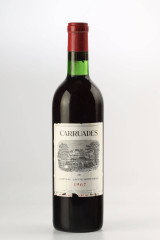
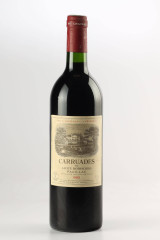
Born in the mid-19th century, forgotten and then reintroduced in the 1960s under the name Moulin des Carruades, the estate's second wine took its current name of Carruades de Lafite in the 1980s. It comes primarily from the Carruades plateau and from parcels excluded from the grand vin, with a higher proportion of merlot that gives it a rounder body and a more immediate appeal. Its vinification is its own, and its aging in oak barrels, somewhat shorter, preserves its fruit. Carruades is not a mere by-product: it is the entry point into the house style, the same grammar of finesse in a version that requires less waiting. To approach the spirit of Lafite without waiting decades, it is often through this wine that one begins.
Lafite is a wine of patience. The sunniest years offer a first plateau of pleasure at around fifteen to twenty years, while the more classic vintages demand even more time before revealing their bouquet of undergrowth, cedar, and gentle spices. Old bottles, when well preserved, rank among the most moving testaments to what the left bank of Bordeaux can age.
This longevity is rooted in the very nature of the wine — great freshness, fine tannins — and in a deliberately measured production of around fifteen to twenty thousand cases per year, far below worldwide demand. International critical recognition has accompanied the estate for generations, consistently placing it among the very foremost references in Bordeaux, a constancy that fuels the attention paid to its old vintages.
Within the Pauillac appellation, Château Lafite Rothschild is part of a viticultural landscape of great qualitative density, where several estates have contributed to shaping the identity and reputation of the appellation. This richness rests on the diversity of gravel terroirs and on complementary styles, ranging from structured power to more refined and approachable expressions.
Among the iconic estates of Pauillac, Château Pichon Longueville Comtesse de Lalande, Château Lynch-Bages, Château Pontet-Canet, Château Grand-Puy-Lacoste, and Château d'Armailhac illustrate the plurality of possible interpretations of the Pauillac terroir. Each one, through its history, its viticultural choices, and its style, actively participates in shaping the image of the appellation.
In this particularly demanding environment, Château Lafite Rothschild stands out for its classic and refined reading of the terroir, favoring elegance, precision, and balance over time. This approach makes it a natural point of reference within Pauillac, allowing one to understand the stylistic diversity and the level of excellence achieved by the appellation as a whole.


