 /
/ 

-
-
-
-
- 1735
- 1748
- 1860
- 1863
- 1879
- 1893
- 1895
- 1897
- 1900
- 1903
- 1904
- 1905
- 1906
- 1908
- 1911
- 1912
- 1913
- 1914
- 1918
- 1920
- 1921
- 1922
- 1923
- 1924
- 1926
- 1927
- 1928
- 1929
- 1930
- 1931
- 1932
- 1933
- 1934
- 1935
- 1936
- 1937
- 1938
- 1939
- 1940
- 1941
- 1942
- 1943
- 1944
- 1945
- 1946
- 1947
- 1948
- 1949
- 1950
- 1951
- 1952
- 1953
- 1954
- 1955
- 1956
- 1957
- 1958
- 1959
- 1960
- 1961
- 1962
- 1963
- 1964
- 1965
- 1966
- 1967
- 1968
- 1969
- 1970
- 1971
- 1972
- 1973
- 1974
- 1975
- 1976
- 1977
- 1978
- 1979
- 1980
- 1981
- 1982
- 1983
- 1984
- 1985
- 1986
- 1987
- 1988
- 1989
- 1990
- 1991
- 1992
- 1993
- 1994
- 1995
- 1996
- 1997
- 1998
- 1999
- 2000
- 2001
- 2002
- 2003
- 2004
- 2005
- 2006
- 2007
- 2008
- 2009
- 2010
- 2011
- 2012
- 2013
- 2014
- 2015
- 2016
- 2017
- 2018
- 2019
- 2020
- 2021
- 2022
- 2023
- 2024
- 2025
-
-
-
-
 Guides for Vintages
-
-
-
-
-
Chateaux
- Angelus
- Ausone
- Beychevelle
- Branaire Ducru
- Calon Segur
- Cheval Blanc
- Cos d'Estournel
- Coutet
- Ducru Beaucaillou
- Figeac
- Giscours
- Grand Puy Lacoste
- Gruaud Larose
- Haut Brion
- La Conseillante
- La Fleur Petrus
- La Mission Haut Brion
- Lafite Rothschild
- Lafleur
- Latour
- Leoville Las Cases
- Lynch Bages
- Margaux
- Montrose
- Mouton Rothschild
- Pavie
- Petrus
- Pichon Longueville Baron
- Pichon Longueville Comtesse
- Pontet Canet
- Rayne Vigneau
- Talbot
- Yquem
- View all
-
-
-
-
MAGNUMS
-
-
-
-
-
Producers
- Bouchard Père Et Fils
- Domaine Armand Rousseau
- Domaine Arnoux Lachaux
- Domaine Bernard Dugat Py
- Domaine de la Romanée Conti
- Domaine des Comtes Lafon
- Domaine Des Lambrays
- Domaine Dujac
- Domaine Georges Roumier
- Domaine Jean Grivot
- Domaine Leflaive
- Domaine Méo Camuzet
- Domaine Mongeard-Mugneret
- Jean Louis Trapet
- Maison Louis Jadot
- Mommessin
- View all
-
-
-
-
MAGNUMS
-
-
-
-
-
-
-
MAGNUMS
-
-
-
-
-
-
MAGNUMS
-
-
-
-
-
-
-
MAGNUMS
-
-
-
-
-
Guides for Vintages
-
-
-
-
-
-
-
Assortments by Estate
-
Assortments by Vintage
-
-
-
Assortments by Region
-
Current Assortments
-
-
-
Create your own assortment
Would you like to create the composition yourself? Contact us!
-
-
-
-
-
-
Guides for Vintages
-












 Contact us


Tips for opening and serving a wine
Stand the bottle upright beforehand
Sediments may form in the bottle. This phenomenon is normal and even more pronounced in older wines. In order to let the sediments settle to the bottom of the bottle, the bottle should be placed in an upright position. This allows for a clean decantation and a pour directly from the bottle without residue (take care not to serve the very bottom of the bottle).
We recommend standing the bottle upright at least 24 hours before serving. So if you plan to open your bottle for a dinner, remember the day before to stand your bottle upright.
How long in advance should the bottle be opened?
In general, the younger the wine, the earlier it should be opened.
Conversely, an old wine should be opened very shortly before tasting.
For a wine still in its youth, it can be opened 1 hour before serving and the use of a decanter can sometimes be useful for optimal aeration of the wine.
For a wine at its peak, a 20-year-old Bordeaux red wine for example, open the bottle a maximum of 30 minutes beforehand.
The wine should not be rushed and decanting is not necessary.
For an old wine, proceed with great care: it is up to us to adapt to its evolution from the moment of opening and not the other way around. An old wine should be opened a maximum of 10 minutes before tasting. Afterwards, let it evolve in the glass and if necessary give it time to open up.
How to open a bottle of wine?
Opening a bottle of wine can be a very delicate operation and it is advisable to have the right tools to ensure everything goes smoothly.
Over time, a cork becomes fragile and this evolution is normal, which is why it is important to proceed step by step in order to extract the cork in one piece.
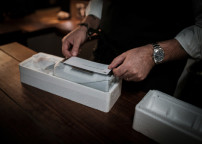
Cut the capsule
Below the neck ring. Clean the outside of the neck with a clean cloth. Any superficial traces of mould are harmless.

Choosing the right corkscrew
- For a wine that is not too old, a waiter's corkscrew may be sufficient.
- For an old wine that may have a very fragile cork, the use of a bilame or a Durand is very strongly recommended.
- Warning: Never use a screw or colonel corkscrew.
- Find our article on opening an old wine
Extract gently
Slow movement, without jerks. Maintain verticality. Stop at the slightest excessive resistance.
What to do if the cork breaks or falls into the bottle?
It is very common that despite all precautions taken, the cork breaks in the neck or pieces fall into the wine. No need to panic — in this case, arm yourself with patience in order to extract and retrieve all the small pieces that could interfere with the tasting. In this case there is no rule; any clean utensil at hand can be used if it is suitable.
At what temperature should wine be served?
The serving temperature of a wine is crucial. An incorrect temperature will directly affect the expression of the wine's organoleptic qualities.
It will always be easier to let a wine warm up at the table or in the glass than to cool down a wine that has been served too warm.
| Wine type | Ideal temperature | To avoid |
|---|---|---|
| Red wines | 16–18 °C | Above 18 °C: alcohol dominant |
| Dry white wines | 13–14 °C | Below 10 °C: aromas blocked |
| Sweet white wines | 10–12 °C | Too warm: loses its freshness |
| Champagnes | 9–11 °C | Too cold: closed aromas |

The serving temperature of a wine is crucial. A wrong temperature will directly affect the expression of the wine's organoleptic qualities.
It will always be easier to let a wine warm up at the table or in the glass than to cool down a wine that has been served too warm.