 /
/ 
















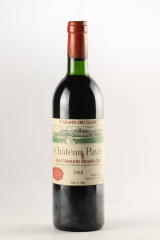
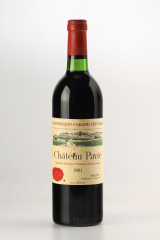


Receive our latest arrivals of Château Pavie directly in your inbox!
Sign up and be the first to hear about new arrivals.

Would you like to create the composition yourself? Contact us!
 Contact us


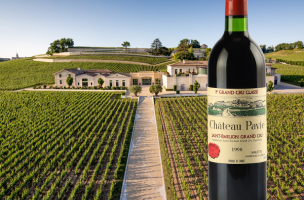
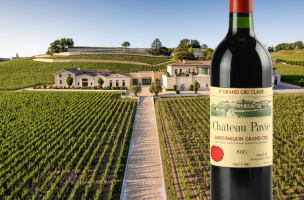
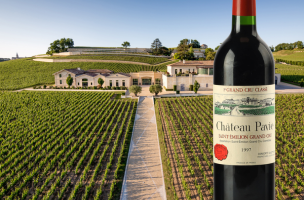
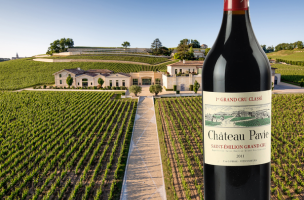
Château Pavie extends over 37 contiguous hectares southeast of the village of Saint-Émilion, on one of the Right Bank's most terraced terroirs: a plateau of asteriated limestone beneath fine clay, a south-facing clay-limestone slope, then sandy-clay foothills. Each soil has its grape variety—Merlot on the plateau, Cabernet Franc on the slope, Cabernet Sauvignon below—resulting in a deep, dense and sun-drenched wine. Acquired by the Perse family in 1998, the estate was promoted to Premier Grand Cru Classé A in 2012 and retained this status in 2022, remaining at the summit of the appellation alongside Figeac.
Its vintages reveal two sides of Pavie: the 1990, a great classic from before the takeover, and Pavie 2005, the pinnacle of the concentrated Perse-era style; younger, the 2019 vintage continues the lineage, with limestone bringing freshness and length.
Read moreFilter
Products (10)
Sign up and be the first to hear about new arrivals.
Our selection of great vintages from Château Pavie...
Pavie brings together the three terroirs of the Saint-Émilion hillside on a single estate—limestone plateau, slope and foothills—producing a particularly powerful, deep wine with excellent aging potential. Since the 2022 revision of the classification, it has also been, alongside Figeac, one of the only two Premiers Grands Crus Classés A in the appellation.
It all depends on the style you are looking for. Vintages from before 1998 offer a more classic, already evolved Pavie; those from the Perse era, beginning in the late 1990s, produce a more concentrated, richer wine. In both cases, the great vintages benefit from patience and can be cellared for several decades.
A young Pavie benefits from being opened and decanted one to two hours before serving, allowing its full character to express itself; older vintages, being more delicate, should be decanted carefully just before sitting down to dinner. Store bottles on their sides, away from light and at a stable temperature. The wine pairs well with red meat, game and aged cheeses.
The name Pavie is associated with one of Saint-Émilion's oldest wine-growing sites: tradition places some of the region's first vines on its slopes, as on those of neighboring Ausone, as early as Antiquity. However, the estate's true wine-growing vocation took shape in the 19th century, when the land was divided among several owner families. Gradually brought together into a single vineyard, Pavie gained in reputation and, in 1954, during the first official classification of Saint-Émilion wines, was recognized as a Premier Grand Cru Classé. The decisive turning point came in 1998, when Gérard Perse, a wine-loving entrepreneur already owner of Monbousquet, acquired the estate. He undertook major work both in the vineyard and winery, replanted the missing parcels, and pushed the wine's ripeness and concentration much further than before. The result was swift: in 2012, Pavie attained the highest rank of Premier Grand Cru Classé A, crowning a spectacular rise in less than fifteen years.
Pavie's strength lies first and foremost in its terroir, an entire side of the Saint-Émilion hill that brings together three very different environments within a single estate. At the very top, the plateau rests on a bed of asteriated limestone—a rock studded with small marine fossils—covered by a thin layer of clay. This limestone acts as a water reserve: it stores winter moisture and slowly releases it to the vines during dry summers, preserving the grapes' freshness. On the south-facing slope, clay mingles with limestone and fully captures the light. Finally, at the foot of the slope, the soils become lighter, sandy-clay and dotted with gravel. This mosaic, from top to bottom, alone explains the wine's range: depth and power, but also tension and freshness.
At Pavie, each grape variety is planted where it performs best. Merlot, by far the dominant variety (around 60% of the vineyard), occupies the clay-limestone plateau, where it brings roundness, flesh and color. Cabernet Franc, planted on the slope, contributes fragrance, finesse and structure. Cabernet Sauvignon, a minority variety, ripens on the warmer soils at the foot of the slope and adds depth and a tannic backbone. The vines, averaging more than forty years old, are harvested by hand. After vinification in temperature-controlled vats, the wine is aged for many months—often between a year and a half and nearly three years—in mostly new oak barrels, which integrate its substance and refine its tannins. The result is a red wine of great stature: dark, rich and palate-coating, with notes of ripe black fruit, licorice, cocoa and spices. At the table, it calls for dishes to match: roasted red meat, game, a fine cut of beef or aged cheese.
Pavie is one of those wines that time elevates. Its great vintages require patience: often closed in their youth because of their dense substance, they blossom after around ten years and can then be kept for several decades, as their initial power gives way to a complex bouquet of candied fruit, truffle, leather and forest floor. This ability to stand the test of time has earned the estate consistent international critical acclaim, placing it among Saint-Émilion's very finest references. It also explains the enduring interest in its bottles, from the great classics produced before 1998 to the vintages of the Perse era, among which the 2010 vintage ranks among the peaks.
Saint-Émilion differs from the great growths of the Médoc in one essential respect: its classification is revised roughly every ten years, making it the most dynamic—and most debated—of Bordeaux's classifications. In 2012, four châteaux shared the highest rank of Premier Grand Cru Classé A: Pavie, Angélus, Ausone and Cheval White. The 2022 revision brought a major upheaval: Angélus, Ausone and Cheval White chose to withdraw from the process, while Figeac was promoted to the top rank. Pavie remained and had its status confirmed: alongside Figeac, the estate is now one of the appellation's only two Premiers Grands Crus Classés A. Compared with its neighbors, each has its own character: Ausone cultivates the finely chiseled minerality of a limestone slope below the village; Cheval White, at the gateway to Pomerol, focuses on Cabernet Franc and a velvety profile; Figeac, on its gravel soils, delivers a straightforward style close to that of the Médoc; Angélus, on the southern slope, favors generosity. With its power and pure limestone terroir, Pavie embodies the appellation's densest and sunniest expression.
Like most great growths, Pavie produces a second wine, Arômes de Pavie, first made with the 2005 vintage. It comes from young vines and lots the estate does not select for its grand wine; more supple and approachable in its youth, it offers an entry point into the house style without requiring long years of waiting. Pavie is also part of a small constellation of properties brought together by the Perse family on Saint-Émilion's finest terroirs, around Monbousquet and Pavie-Decesse—estates that share the same pursuit of ripeness and precision.