 /
/ 
























Receive our latest arrivals of Château Rayas directly in your inbox!
Sign up and be the first to hear about new arrivals.

Would you like to create the composition yourself? Contact us!
 Contact us


Domaine Rayas is located in the southern Rhône Valley, at the heart of the Châteauneuf-du-Pape appellation. Founded by Albert Reynaud and passed down through four generations, this iconic family estate covers only 10 hectares of vines. Situated apart, amid the woods, on very sandy and poor soils, Rayas produces wines of a finesse and elegance unique within the appellation. Grenache is the principal variety for the reds, while the whites are made from Grenache Blanc and Clairette.
Long directed by Emmanuel Reynaud, who recently passed away, the estate today perpetuates his legacy and singular style, making each Rayas vintage a rare and unique wine. Among the iconic vintages of Rayas are notably the Rayas 1990, 2006 vintage, 2007 wine, Rayas 2009 and the 1989 vintage, essential references of Châteauneuf-du-Pape.
Filter
Products (10)
Sign up and be the first to hear about new arrivals.
The history of Château Rayas begins in 1880, when Albert Reynaud acquired this corner of countryside north of Châteauneuf-du-Pape. His son Louis was a true pioneer: he was among the very first winemakers in the appellation to bottle his wine at the estate, at a time when most sold their harvest in bulk. Then came Jacques Reynaud, a discreet and elusive figure, who ran the property from 1978 until his sudden passing in 1997. His nephew Emmanuel then took over, gradually imposing his own stamp, until his own passing in 2025. Four generations of the same family thus succeeded one another without ever seeking the spotlight, faithful to a simple idea: letting the place express itself. This family continuity, and the constant refusal to follow trends, largely explain the aura that surrounds the estate's bottles today.
What sets Château Rayas apart begins with the soil. The renown of Châteauneuf-du-Pape has been built on its famous galets roulés, those large stones polished by the Rhône that absorb the heat of the day and release it at night. Rayas, however, goes against the grain: its vines are planted in fine, poor sandy soils, nestled in a clearing surrounded by pine trees, away from the stony plateaus. This sand retains freshness, tempers the vigor of the vine, and naturally produces low yields. The result: the grapes ripen more slowly, and the estate typically harvests among the last in the appellation. Where the neighboring terroir pushes toward power and warmth, that of Rayas seeks finesse and restraint. This is the estate's great paradox: producing, in the heart of the sunny south, a wine that evokes the freshness of the great terroirs further north.
In Châteauneuf-du-Pape, the regulations permit thirteen grape varieties, and most estates compose blends in which Syrah and Mourvèdre provide color and structure. Château Rayas takes the opposite approach: its great red is a pure Grenache, a single variety. This choice, rare within the appellation, explains the wine's silhouette — an often pale, almost transparent robe that surprises those expecting a dark, massive red. On the nose as on the palate, one finds cherry, wild strawberry, a hint of herbs and gentle spices. The winemaking remains deliberately simple: grapes harvested fully ripe and as whole clusters, fermented in concrete vats, then aged in old foudres and large wooden barrels, with no new oak, so as never to mask the fruit. The white, more understated, blends Grenache Blanc and Clairette. At the table, the red pairs equally well with roasted poultry, a slow-cooked dish, or a pan of sautéed mushrooms.
Should you wait before opening a Château Rayas? In its youth, the wine often appears reserved, almost closed in on itself in the months following bottling. It needs time — often around ten years — to open up and reveal the register of undergrowth, candied fruit, and spices that defines its signature when mature. The great sun-drenched vintages of past decades have long since crossed that threshold and can today be enjoyed in their full splendor. This ability to travel through time without hardening has forged the estate's reputation well beyond France's borders: for decades, international critical acclaim has accompanied each of its vintages, and Rayas now stands among the very top references of Châteauneuf-du-Pape, to the point of becoming a cult name, sought after by enthusiasts the world over.
Comparing Château Rayas to its neighbors sheds light on its singularity. On the plateau of La Crau, Domaine du Vieux Télégraphe embodies classic Châteauneuf-du-Pape of the galets roulés: a powerful, ample wine built on the traditional blend. Château de Beaucastel takes the blending philosophy even further, giving a prominent place to Mourvèdre for a deep, long-aging style. Domaine Henri Bonneau, more understated, shares with Rayas a devotion to Grenache and patience, with cuvées produced in very small quantities. Against them, Rayas holds a unique position: that of a wine which, on its sand and its single variety, plays on finesse where the appellation readily cultivates power. It is this diversity of styles that makes the great wines of the Rhône Valley so rich and invites one to compare several estates at the same table.
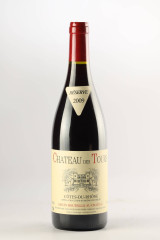
To stop at the single grand wine would be to overlook part of the story. Under the same hand, the Reynaud family produces Pignan, a second red also made from Grenache, born from a neighboring parcel and often presented as a more immediate entry point into the estate's universe. A few kilometers away, Château de Fonsalette produces Côtes du Rhône wines reputed to be capable, in great vintages, of rivaling many more prestigious crus. Finally, the family extends its philosophy to Sarrians, where Château des Tours produces a Vacqueyras and Domaine des Tours simpler cuvées on more accessible appellations, from Vacqueyras to Vaucluse country wines: the same love of Grenache, the same refusal of over-extraction, the same wines that gain from aging. For the enthusiast, this galaxy offers a more affordable way to approach a style that has become, alongside the grand wine of Rayas, one of the most imitated and most difficult to equal signatures of the southern Rhône.