 /























Receive our latest arrivals of 1939 Wine directly in your inbox!
Sign up and be the first to hear about new arrivals.

Would you like to create the composition yourself? Contact us!
 Contact us

The 1939 vintage was the first harvest brought in under wartime mobilization: when war was declared in early September, men were called away just as the harvest began, leaving the work to be done in haste. In Bordeaux, the reds emerged light, fresh and fruity, defined by elegance rather than power and suited to moderate aging. The year’s true success came in Sauternes, where dry weather in late September yielded concentrated sweet wines with impressive longevity. Elsewhere in France, the year was difficult, and fortified wines — old Armagnac and Madeira — produced its most resilient bottles. Château Mouton Rothschild 1939 remains the vintage’s most accomplished red, while Château d’Yquem 1939 is its benchmark sweet wine. To place 1939 among the other years of its century, consult our Vintage Guide.
Filter
Products (4)
Sign up and be the first to hear about new arrivals.
1939 was an average, mixed year. In Bordeaux, the harvest took place in mild weather and produced fresh, fruity, decent reds that have held up fairly well over the decades, though they were not intended for very long aging. The year’s standouts were the sweet wines of Sauternes, well above the rest. Elsewhere, the year was difficult, and the war prolonged the aging of many wines, which were bottled late. On the Right Bank, a well-sourced Château Cheval Blanc remains a reliable choice for anyone seeking a pre-1940 red that is still enjoyable.
At this age, provenance and storage are everything. Examine the fill level, color, condition of the label and any recorking, and prioritize bottles with impeccable provenance. Among the reds, the Left Bank’s classified growths of Bordeaux, with their firm tannic structure, have weathered the decades best. Sweet and fortified wines offer an even greater margin of safety, as their richness makes them naturally more resistant to time.
Someone born in 1939 turns 87 in 2026: it is not a milestone birthday, but their birth year is an ideal way to mark a personal occasion with a bottle from the same year. As the light reds of 1939 are becoming scarce, wines and spirits built to last—sweet Sauternes, old Armagnac, and Madeira—make the most reliable gifts: they keep well and can be enjoyed more than eighty years later. Always check the fill level and condition of the bottle before buying.
The 1939 vintage marks the start of the war years. September’s mobilization drew workers away from the vineyards at the worst possible moment, and the harvest was rushed. The results bear its mark: respectable but modest Bordeaux reds, genuine success in Sauternes, and a much more difficult year elsewhere in France. What makes 1939 interesting today is as much its history as its quality: time has done the sorting, and only wines built to last remain in good condition. This page therefore looks at each region in turn, distinguishing wines still worth drinking from those of primarily collectible interest.
The 1939 Bordeaux reds are all about finesse. Harvested in favorable weather, they offer a light body, clear fruit and freshness that has held up well, though without the substance of great age-worthy vintages. The Left Bank produced the most accomplished wines, with supple tannins and bouquets now fully evolved; the Right Bank yielded balanced, charming reds that are even more approachable. One peculiarity of this wartime year: many wines spent an unusually long time aging before bottling, which circumstances had delayed.
At the top of the hierarchy, Mouton Rothschild remains the vintage’s most complete red, alongside Château Margaux, whose 1939 displays an airy elegance and surprising freshness, and Château Haut-Brion, true to its consistent performance in difficult years. On the Right Bank, Cheval Blanc remains the benchmark for the year’s reds that are still vibrant. At this level, every bottle is unique: storage quality, far more than the year’s reputation, makes the difference.
Aging potential: open the reds for their freshness when the fill level is high; reserve the premiers crus for knowledgeable collectors, after checking the fill level and whether the bottle has been recorked.
Sauternes is where 1939 shows its best. Dry weather in late September allowed the grapes to be harvested in good conditions, while the rest of the wine regions struggled. Botrytis — the noble rot that concentrates the grapes and gives great sweet wines their richness — was less prevalent than in a typical year, but concentration and acidity were both present, promising remarkable longevity. The best bottles still retain freshness today, along with aromas of candied fruit, honey and spice that belie their age.
Yquem is naturally the most sought-after wine of the year, proof that a great Sauternes terroir can produce a sweet wine built to age even under unfavorable conditions. The Sauternes appellation also saw successes among neighboring classified estates, notably Suduiraut and Rieussec, while in Barsac, the more taut style of Château Climens was ideally suited to this cool year. These are by far the safest bottles of the vintage to drink.
Aging potential: sweet wines remain vibrant and expressive if the fill level is good; reliable choices to open with confidence when the bottle has been well stored.
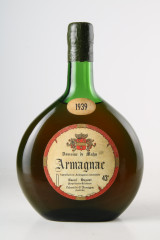
As the 1939 still wines begin to fade, brandies and fortified wines come into their own. The alcohol content of old Armagnac and Madeira’s oxidative aging act as natural preservatives, allowing a vintage to last well beyond eighty years without losing its character. Madeira deserves particular attention: this fortified wine from the Portuguese island is heated over a long period and aged in contact with air, making it nearly indestructible. A single-vintage Madeira is one of the most reliable and accessible ways to taste a wine from 1939 as it once was.
In France, the year’s Bas-Armagnacs, rooted in the long-aging tradition of the Southwest, demonstrate the longevity of Armagnac brandies; from Portugal, a Madeira from Camara de Lobos makes the same case. These bottles need no prolonged decanting, withstand the passage of decades remarkably well and make a particularly reliable birth-year gift.
Aging potential: 1939 Armagnac and Madeira remain perfectly drinkable today and will be for a long time; the most reliable way to experience the vintage.
Outside Bordeaux, 1939 was a distinctly difficult year. Burgundy experienced a cold, unsettled growing season that produced thin reds and lackluster whites. The Rhône Valley was among the hardest-hit regions, with both volumes and quality down. In Champagne, most houses chose not to declare a vintage and used their grapes in nonvintage blends. Everywhere, surviving bottles are primarily of historical interest.
In such circumstances, only the very greatest terroirs produced wines capable of lasting through the decades. In Burgundy, Domaine de la Romanée-Conti is among the exceptionally few estates whose 1939 wines still merit an enthusiast’s attention, more for their aromatic development than their power. In the Rhône Valley, as in Champagne, bottles from that year surface only as cellars become available and are valued chiefly for their extreme rarity.
Aging potential: exceptionally rare bottles, to be opened only with an impeccable storage history; collector’s items above all.
Choosing a 1939 wine means accepting the rule of old vintages: quality depends less on the year’s reputation than on its terroir and storage conditions. Bottles from this wartime harvest become available only as we acquire cellars; set up an alert on this page to hear about each new arrival, and place 1939 among the other years of its century with our SoDivin Vintage Guide. Every bottle offered is professionally assessed and checked — fill level, label, provenance — then shipped the same day for orders placed before 2 p.m. in protective packaging, with high-definition photos provided.