 /
/ 






















Receive our latest arrivals of Château Latour directly in your inbox!
Sign up and be the first to hear about new arrivals.

Would you like to create the composition yourself? Contact us!
 Contact us


Château Latour is one of the oldest and most defining estates in the Pauillac appellation. Classified as a Premier Grand Cru Classé in the official 1855 classification, it embodies a rigorous and architectural vision of great Bordeaux wine, built on consistency, depth and longevity. Closely linked to the Gironde estuary, the vineyard benefits from particularly favourable natural conditions for the regular ripening of grapes and a precise expression of the terroir.
The style of Château Latour is built on a dominance of Cabernet Sauvignon, giving rise to powerful, dense wines constructed to express themselves over time.
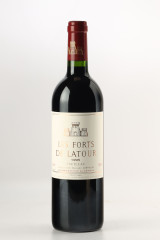
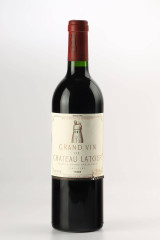
Among the iconic vintages of Château Latour are notably: the 1964 vintage and the 1989 wine alongside a still young 2000, complemented by the mythical 1986 red wine and 1988. Les Forts de Latour, the estate's second wine, opens the same signature across more accessible years.
Read moreFilter
Products (21)
Sign up and be the first to hear about new arrivals.
A stronghold is attested on the site as early as 1331, and a watchtower was erected in the second half of the 14th century on the bank of the estuary: the Tour de Saint-Lambert, which gave its name to the place long before it came to designate a wine. The vineyard entered the history of Bordeaux wine with the de Ségur family, who held it for nearly three centuries. In 1718, Nicolas-Alexandre de Ségur, whom his contemporaries nicknamed the Prince of Vines, brought several of the future first growths of the Médoc under a single authority: Latour and Lafite belonged at that time to the same house. Thomas Jefferson visited the vineyard in 1787, at a time when Latour wines were already circulating at exceptional prices on the English market. The château seen today is not the medieval tower but a building erected between 1862 and 1864. The estate passed under British control in 1963, Allied Lyons took a majority stake in 1989, then François Pinault acquired it in 1993 and entrusted the management of the estate to Frédéric Engerer in 1995. A long cycle of investment then began, of which the renovation of the vat room in 1998 was the most visible undertaking.
Under this impetus, Château Latour has become a pioneer in several respects. The estate is today the only Premier Grand Cru Classé conducted entirely under organic farming, a certification obtained in 2018, and also the only one to have chosen to cease selling its wines en primeur, a decision applied since the 2012 vintage. These orientations reflect a firm commitment to prioritising the maturity, readability and coherence of the wine over the long term.
The Château Latour vineyard is located at the southern tip of the Pauillac appellation, in immediate proximity to the Gironde estuary. It rests on deep gravel soils combined with a clay subsoil, offering a natural balance between drainage and water retention. This geological configuration, rare in its homogeneity, gives the wines a dense structure and a great consistency of expression, even in climatically contrasting vintages.
The grape variety composition is largely dominated by Cabernet Sauvignon, complemented by Merlot, Cabernet Franc and Petit Verdot. Vineyard work is based on an extremely rigorous plot-by-plot selection and controlled yields. The winemaking process favours precision and purity of expression, with measured extractions and barrel ageing aimed at supporting the wine's structure without altering its balance.
The style of Château Latour is characterised by a powerful tannic architecture, remarkable depth and a capacity to unfold slowly over the years. The wines offer a structured and mineral reading of the Pauillac terroir, where freshness and density achieve lasting balance.
Château Latour produces a second wine, Les Forts de Latour, sourced from distinct plots or younger vines. This cuvée benefits from the same level of technical and stylistic rigour, while offering a more accessible expression of the terroir. A third wine, Pauillac de Château Latour, completes the range and allows for a particularly strict selection for the grand vin.
Within the Pauillac appellation, Château Latour stands in a viticultural environment of exceptional density. Estates such as Château Pontet-Canet, Château Lynch-Bages, Château Pichon Longueville Comtesse de Lalande and Château Grand-Puy-Lacoste illustrate the diversity of styles and possible interpretations of the Pauillac terroir. In this context, Château Latour stands out for a more rigorous and structural approach, constituting an essential benchmark for understanding the most enduring and architectural dimension of the appellation's great wines.


