 /
/ 























Receive our latest arrivals of Petrus directly in your inbox!
Sign up and be the first to hear about new arrivals.

Would you like to create the composition yourself? Contact us!
 Contact us


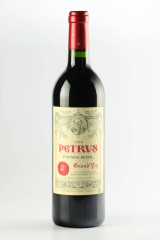
Petrus is the most emblematic wine of the Pomerol appellation, on the Right Bank of Bordeaux, and one of the absolute benchmarks of great French wines. Produced from a confidential vineyard located on the clay plateau of Pomerol, the estate stands out for the singularity of its iron-rich clay terroir and for an exceptional interpretation of Merlot, the near-exclusive grape variety of the blend.
In the absence of an official classification in Pomerol, Petrus has built its reputation solely on the consistency of its quality, the depth of its wines and their remarkable aging capacity.
Its great vintages mark the modern history of Pomerol. The 1961 wine ranks among the post-war pinnacles, followed by the 1982 vintage, which opened the series of solar years driven by fully ripe Merlot, before more recent great successes such as the 2000 vintage and 2016 brought the estate to its highest point. More approachable today, the Petrus 2017 illustrates the estate's consistent quality.
Read moreFilter
Products (6)
Sign up and be the first to hear about new arrivals.
On the Pomerol plateau, Petrus built its reputation without the aristocratic aura of the great châteaux of the Médoc, but with a commitment to quality asserted very early on. In the hands of the Arnaud family since the 18th century, the estate long remained a little-known wine before gaining international recognition during the 20th century, driven by the consistency of its style and the singularity of its terroir.
This ascent owes much to Madame Edmond Loubat, a central figure in the history of the estate. She gradually bought back Petrus from the Arnaud family starting in the 1920s and became its sole owner at the end of the Second World War. Passionate and a skilled communicator, she brought the wine to the finest tables and notably arranged for bottles to be sent to Buckingham Palace for the coronation of Queen Elizabeth II in 1953 — an episode that helped make Petrus known well beyond the borders of France.
The modern identity of the estate was then shaped around the Moueix family, who first managed its distribution and later its ownership. Petrus made the deliberate choice to produce only a single wine, with no second wine or diversification — a rare distinction in Bordeaux that reinforces the coherence and clarity of its project. Production remains limited to a few thousand bottles per year, which sustains its rarity and the interest of collectors worldwide.
The Petrus vineyard extends over just over eleven hectares, at the highest point of the Pomerol plateau. The soil consists of heavy, deep clay, rich in iron oxides, resting on a subsoil capable of retaining water and then releasing it slowly to the vine, even during the driest summers. This natural regulation promotes slow and complete ripening of the Merlot and yields wines of uncommon density and depth.
The absence of the gravelly soils that characterize the Médoc clearly distinguishes Petrus from other great Bordeaux wines and explains its expression, centered on texture, depth and length on the palate rather than on sheer power alone. The Pomerol appellation, one of the smallest among the great terroirs of the Right Bank, has no official classification: each estate has made a name for itself solely through the quality of its wines, and Petrus is the most striking example of this.
The grape variety composition relies almost exclusively on Merlot, complemented by a share of Cabernet Franc that has become marginal, or even absent depending on the vintage. Yields are deliberately low and vine selection is particularly rigorous: each parcel is harvested at perfect ripeness, with a constant focus on the balance between richness, freshness and fruit precision.
Vinification is carried out with precision, without seeking excessive extraction. Aging in barrels, partly new, accompanies the wine without ever masking the expression of the fruit or the terroir. The result is an easily recognizable style: a velvety texture, remarkable concentration and an aromatic profile that evolves from ripe dark fruits toward notes of truffle, cocoa and spice over time. At the table, a mature Petrus pairs beautifully with delicate meats, feathered game or truffle-based dishes, served at around seventeen degrees and decanted to allow it to open up.
Petrus wines rank among the greatest age-worthy wines in the world. In great vintages, such as the 2010, they evolve harmoniously over several decades and often reach their peak after twenty to thirty years, sometimes more. Their aging reveals a remarkable aromatic complexity, supported by a powerful yet perfectly integrated structure. For still-young vintages, extended cellaring remains preferable in order to reveal their full dimension.
International critical recognition has accompanied the estate for decades: it underscores the singularity of Petrus among the great wines of Bordeaux and its ability to stand at the very highest level outside any official classification. This consistency, vintage after vintage, explains the place the estate holds in the finest cellars in the world.
Within Pomerol, Petrus holds a position apart, while remaining part of an exceptional environment. It stands alongside other emblematic estates of the appellation: Le Pin, recognized for its exclusive character, Lafleur, appreciated for its rigor and longevity, Latour à Pomerol, and Vieux Château Certan, renowned for its balance and finesse. Through its clay terroir and inimitable style, Petrus contributes fully to the worldwide reputation of Pomerol, a land of expression for Merlot at the highest level.


