 /
/ 



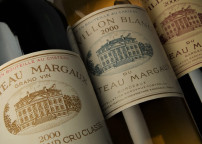
















Receive our latest arrivals of Château Margaux directly in your inbox!
Sign up and be the first to hear about new arrivals.

Would you like to create the composition yourself? Contact us!
 Contact us


Château Margaux gives its name to the Margaux appellation, on the left bank of the Médoc, and is counted among the five 1855 first classified growths. Its estate covers approximately 265 hectares, of which around one hundred are planted with vines, on fine, deep gravels over a limestone subsoil that drains water naturally. Cabernet Sauvignon dominates the grape variety composition, complemented by Merlot, Cabernet Franc and Petit Verdot. From this terroir comes a wine recognized for its silky texture, its scent of violet and iris and its length — a particularly refined expression of the Médoc.
The 1995 vintage belongs to the estate's pre-war peaks, while the 1982 wine opens the modern series of its greatest successes. More recently, the 2015 vintage, regarded as one of the most accomplished of the estate, coincides with the inauguration of its new winery. From one decade to the next, the style of Château Margaux gains in complexity without losing any of its elegance.
Read moreFilter
Products (9)
Sign up and be the first to hear about new arrivals.
Château Margaux has established itself over several centuries as a major reference in the Bordeaux vineyard. Traces of viticulture are attested as early as the 12th century, but it was in the 18th century that the estate experienced its decisive rise, driven by growing recognition on European markets. The precision of the viticultural work and the constant pursuit of balance contributed early on to forging the reputation of the wines produced from this singular terroir.
Its classification as a Premier Grand Cru Classé in the official 1855 classification durably consecrated the estate's status and confirmed its structuring role in the history of the great wines of Bordeaux. Château Margaux then joined an extremely restricted circle of properties placed at the summit of the Bordeaux hierarchy, alongside Château Lafite Rothschild, Château Latour and Château Haut-Brion, later joined by Château Mouton Rothschild. This institutional recognition definitively establishes Château Margaux as one of the historic pillars of its appellation.
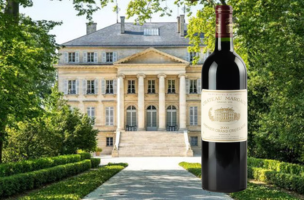
The neoclassical architecture of the château, built in the early 19th century, plays a full part in the identity of the estate and reflects the determination to act with a long-term vision. Over successive generations, Château Margaux has played a central role in defining the style of the Margaux appellation, founded on finesse, harmony and precision.
The vineyard of Château Margaux is located at the heart of the Margaux appellation, on the left bank of Bordeaux. It rests on soils of fine, deep gravels mixed with sands, over a limestone subsoil, offering optimal natural drainage. This geological configuration promotes regular water supply to the vine and progressive ripening of the grapes, essential conditions for the aromatic expression and balance of the wines.
The climatic influence of the Gironde estuary contributes to the consistency of vintages, by limiting thermal extremes and preserving the natural freshness of the grapes. This context allows the terroir to express itself with great clarity, giving rise to wines that are both elegant and deeply rooted in their origin.
The grape variety composition of Château Margaux is dominated by Cabernet Sauvignon, complemented by Merlot, Cabernet Franc and Petit Verdot. Work in the vineyard is based on a rigorous plot-by-plot approach, combined with controlled yields and constant attention paid to the optimal ripeness of the grapes. Vinifications favor gentle extractions in order to preserve the aromatic finesse and the texture of the tannins.
Aging in barrels accompanies the structure of the wine without masking its expression. The style of Château Margaux is characterized by a silky texture, great aromatic precision and progressive complexity, marked by floral notes, black fruits and fine spices. Balance and harmony constitute the estate's constant signature.
Château Margaux produces a second wine, le Pavillon Rouge du Château Margaux, drawn from specific plots or younger vines. This cuvée benefits from the same level of technical and stylistic rigor, while offering a more immediate expression of the terroir. The estate also produces the Pavillon Blanc du Château Margaux, a dry white wine made predominantly from Sauvignon Blanc, recognized for its precision, freshness and aromatic complexity.
Thanks to their natural balance, the fineness of their tannins and their aromatic freshness, the wines of Château Margaux possess a remarkable ability to evolve harmoniously over several decades. This aging potential, combined with great stylistic consistency, allows the wines to gain in complexity and depth while preserving their original elegance.
Within the Margaux appellation, Château Margaux occupies a founding and structuring position. Renowned estates such as Château Palmer, Château Rauzan-Ségla, Château Brane-Cantenac and Château Giscours illustrate the diversity of possible interpretations of the Margaux terroir. In this qualitatively rich environment, Château Margaux stands out for a particularly refined and balanced expression, constituting an essential benchmark for understanding the identity and style of the great wines of Margaux.